CWDM vs DWDM: wavelengths, channels and distance explained
One fiber pair and not enough capacity? How CWDM and DWDM differ in wavelengths, channels, distance and cost, and when to pick which.
You have one fiber pair between two sites and you need more links than that pair can carry. Getting an extra pair of dark fiber costs time and money, if it's available at all. This article explains how CWDM and DWDM solve that, how they differ in wavelengths, channels, distance and cost, and how to decide which one fits your link.
What WDM actually does
The idea is simple. You send several signals over the same fiber, each on its own wavelengthWellenlänge Die Wellenlänge des Lichts in Nanometern. Üblich sind 850 nm (Multimode), 1310 nm und 1550 nm (Singlemode); beide Seiten einer Verbindung müssen dazu passen.. At both ends a passive mux/demux combines the colors and splits them again. Each switch port gets an optic with exactly one fixed wavelength, and that optic is patched to the matching port on the mux.
To the switch it's just a link. The difference between CWDM and DWDM is how closely the channels are packed, and that drives almost everything else: how many channels you get, how far you can go and what it costs.
CWDM: 18 channels, 20 nm apart
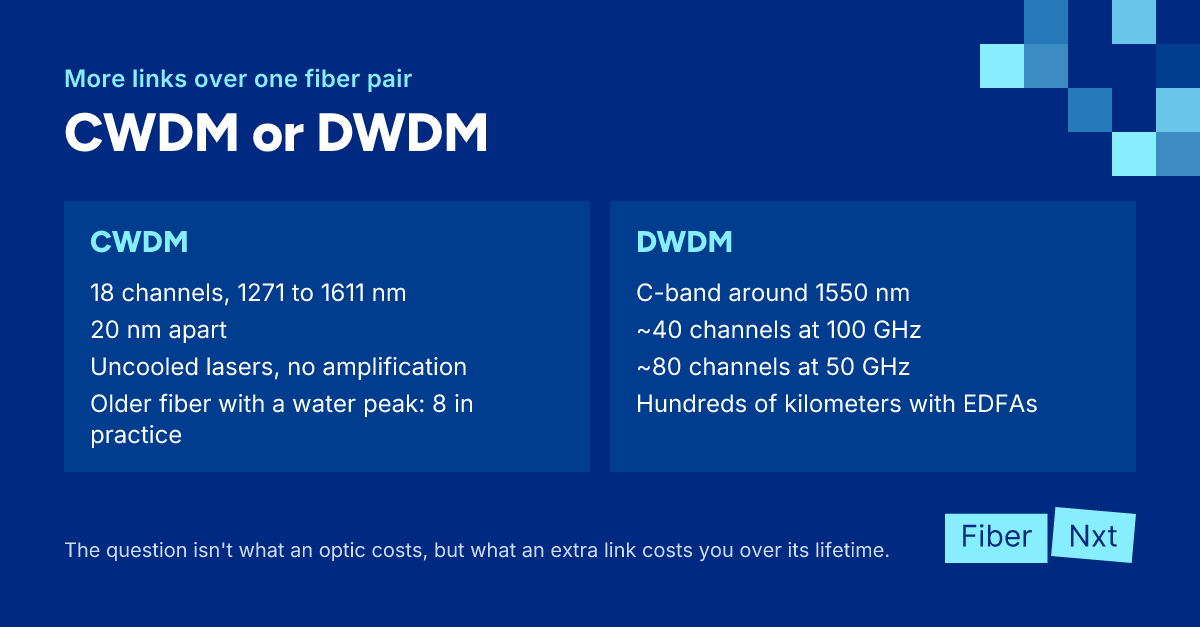
CWDM (coarse) follows the ITU-T G.694.2 grid: 18 channels from 1271 to 1611 nm, with 20 nm channel spacing. Datasheets sometimes still say 1470 or 1490 nm; those are the old labels for the same channels, which have sat at 1471 and 1491 nm since 2003.
That wide spacing is the whole trick. A laser drifts with temperature, but with 20 nm between channels that's fine. CWDM optics therefore use uncooled lasers and simple filters, which makes them cheaper and less power-hungry than DWDM.
The downside:
- No amplification — most CWDM channels fall outside the window of an EDFA, the optical amplifier that works around 1550 nm. Your distance is set by the optic's power budget minus fiber and mux loss. Typically that's up to around 40 to 80 km, depending on the optic.
- The water peak — older fiber has extra attenuation around 1383 nm. On that fiber the channels in that region drop out and you're left with eight in practice, from 1471 nm up. On low-water-peak fiber (G.652.D) you can use all 18. If you don't know what's in the ground, ask your fiber provider.
- Each channel is wide — 18 channels is the ceiling. Beyond that, more capacity only comes from higher speeds per channel.
DWDM: dozens of channels around 1550 nm
DWDM (dense) follows ITU-T G.694.1, a grid defined in frequency rather than wavelength, anchored at 193.1 THz. Common channel spacing is 100 GHz or 50 GHz; around 1550 nm that's roughly 0.8 and 0.4 nm. The channels live in the C-band (roughly 1530–1565 nm), which fits around 40 channels at 100 GHz or around 80 at 50 GHz, depending on the system.
Channels packed that tightly need a laser that doesn't drift. DWDM optics are cooled and cost more per unit. In return you get two things:
- Far more channels — on the same fiber pair.
- Amplification — because everything sits in the C-band, you can amplify with EDFAs. That takes you hundreds of kilometers, where CWDM stops at the power budget of a single optic.
Cost: per channel versus per fiber
This is where the trade-off often goes wrong. Per optic, CWDM is clearly cheaper. But the real question isn't what an optic costs, it's what an extra link costs you over its lifetime.
- Short distance, limited growth — between two data centers in the same region, with a handful of 10G links, CWDM is almost always the sensible choice. Passive, simple, cheap.
- Long distance or many channels — if you need to go beyond 80 km, or you expect to need more than 18 links within two years, DWDM can work out cheaper than leasing a second fiber pair. Weigh the optics premium against what that pair costs you per year.
- When in doubt — don't start with an eight-channel CWDM mux if you already know you'll grow. Swapping a mux means re-patching every link, which means a maintenance window.
When to use which
A few situations we see a lot:
- Dark fiber between two DCs in the region — CWDM, unless distance or link count rules it out.
- Adding capacity on one existing pair — CWDM if it fits. Hit the ceiling and you can replace one CWDM channel around 1550 nm with a block of DWDM channels, using a mux built for that.
- Metro or longer, with growth — DWDM, amplified if the distance calls for it.
And in every case: run your power budget, including the insertion loss of every mux/demux and every connector. Take those values from the datasheets, not from memory.
We'd like to think along with your design
CWDM and DWDM optics and muxes are deliberately not in our webshop. With WDM everything has to line up: fiber type, distance, channel count now and later, your switch platform and the coding. A set of optics that almost fits costs you more than the conversation up front.
So do it the other way round. Send us your situation: the distance, the fiber type if you know it, how many links you need now and in two years, and which switches sit at both ends. We'll run the power budget, put together the channels and the mux, and send you a quote. Our optics come from Solid Optics, who test CWDM and DWDM across varying temperatures with an OSA.
Call or email an engineer with your design, or check our services if you'd like the link tested and documented afterwards as well.

Gründer von FiberNxt und Xyphen IT
Yvan Watchman ist Gründer von FiberNxt und Xyphen IT. Er baut und betreibt seit Jahren Netzwerke und Rechenzentrumsinfrastruktur in und um Amsterdam.
Passende Produkte und Dienstleistungen
Häufig gestellte Fragen
Can I combine CWDM and DWDM on the same fiber?
Yes, but it's a design decision, not plug-and-play. DWDM channels sit around 1550 nm, inside the range of one or two CWDM channels. With a mux built for it, you replace such a CWDM channel with a block of DWDM channels. Count the insertion loss of both muxes in your power budget.
How many channels do I get with CWDM?
The ITU grid (G.694.2) defines 18 channels from 1271 to 1611 nm. On older fiber with a water peak around 1383 nm, the channels in that region are unusable and you're left with about eight in practice, from 1471 nm up. On modern low-water-peak fiber (G.652.D) you can use all 18.
Why aren't CWDM and DWDM optics simply in the webshop?
Because the right choice depends on your fiber, your distance, your mux and your platform. We'd rather look at your design first than have you order a set of channels that almost fits. Send us your situation and you'll get a quote that matches it.