Why FiberNxt works with Solid Optics
Where do our optics come from, who tests them and what happens when one isn't right? On Solid Optics, testing, lifetime warranty and how we count RMAs.
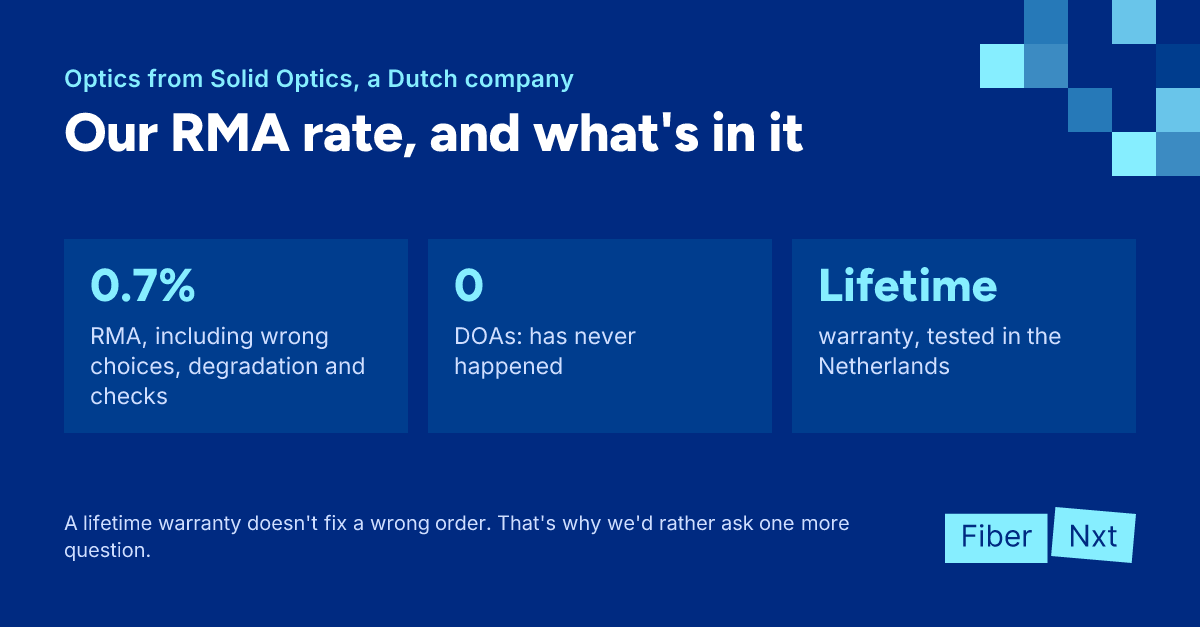
When you buy optics from us, you want to know three things: where they come from, who tests them, and what happens if one isn't right. The short answer: they come from Solid Optics, they're tested in the Netherlands, and they carry a lifetime warranty. This article covers what that means for you in practice, how we count our RMA rate, and where the limits are.
Who Solid Optics is, and how we're connected
FiberNxt is part of Innovation Harbor. Solid Optics is Innovation Harbor's main supplier of optical equipment. Solid Optics is a Dutch company.
That sounds like a detail, but it's the reason we work with them. When you have a question about a transceiverTransceiver Steckbares Modul, das elektrische Signale eines Switches oder einer NIC in Licht (oder Kupfer) umwandelt und zurück. Sender und Empfänger in einem Gehäuse, zum Beispiel ein SFP+ oder QSFP28., you're talking to people who know the product, in the same time zone, and who can put the module on a test bench themselves.
What that gets you
This is what Solid Optics commits to on its own site, and what it means for you as a customer:
- Lifetime warranty — on all their transceivers.
- A test report per item — every unit that ships has its own test report, not just a sample per batch.
- Batch and individual testing — with full traffic on the equipment the module is intended for. A module meant for Cisco runs its test on Cisco equipment, with the matching codingCodierung Die Herstellerkennung im EEPROM eines Transceivers. Viele Switches akzeptieren nur Optiken, die für die eigene Marke codiert sind..
- CWDM and DWDM under fluctuating temperatures — measured with an OSA, so the wavelength stays where it should when it gets hot or cold.
- Advance replacement — if something does go wrong, the replacement can be on its way before the faulty module is back.
Testing before you roll out
A test report says the module worked on the test setup. For most customers that's enough. Sometimes, though, you want certainty on your own platform, with your own software version. There are three ways to get it:
- We test first — we can test a module before it ships to you.
- Solid Optics tests on your equipment — they test locally in the Netherlands, have a complete test line for all vendors, and can also test on the customer's own equipment.
- We test on site — our Optics & link test (Link Ready) measures power levels and runs a basic OTDR, with the results documented.
That last one is especially useful for a new rollout: you don't just know the optics work, you know the fiber in between is fine too.
Our RMA rate, and what we count
Our RMA rate so far is 0.7%. That number only means something if you know what's in it, so here's the definition. Everything that comes back counts:
- Wrong choice — a module that turned out not to be right for the application, for example a different reach or wavelength.
- Degradation — a module that deteriorated over time.
- Checks — a module we took back to have it checked, even if nothing turned out to be wrong.
What's not in it, because it has never happened: a DOA, or a module that didn't work on delivery.
Solid Optics itself publishes an RMA rate of less than 0.01%. That looks contradictory, but the two numbers don't count the same thing. Ours is deliberately broad: returns where nothing was wrong with the module itself still count. We'd rather give you an honest number with its definition than a pretty number without one.
Where the limits are
A lifetime warranty doesn't fix a wrong order. A BiDi pair with the same half twice, or a module with the wrong coding, isn't a defect: it's the wrong choice. That's why, when in doubt, we'd rather ask one more question before we ship.
And not every variant is always in stock. What we have, you can see in the shop. What isn't there, we can order, and we'll tell you honestly up front when it will arrive.
What to do next
Browse our optics range; for each module you pick the coding for your platform. Want a module tested first, or a rollout delivered with link tests? Have a look at our services, or call an engineer.

Gründer von FiberNxt und Xyphen IT
Yvan Watchman ist Gründer von FiberNxt und Xyphen IT. Er baut und betreibt seit Jahren Netzwerke und Rechenzentrumsinfrastruktur in und um Amsterdam.
Passende Produkte und Dienstleistungen
Häufig gestellte Fragen
What does the lifetime warranty cover?
Solid Optics gives a lifetime warranty on all their transceivers and offers advance replacement, so a replacement can be on its way before the faulty module is back. You don't have to deal with Solid Optics yourself: contact us and we'll handle it.
Can you test a module on my own equipment?
Yes. We can test a module ourselves first, and Solid Optics can test on the customer's own equipment. On site, our Optics & link test (Link Ready) measures power levels and runs a basic OTDR, with documented results.
Why is your RMA rate higher than Solid Optics' own figure?
Because we measure something different. We count every return, including a module that turned out to be the wrong choice or one we only took back for a check. That puts us at 0.7%. Solid Optics states less than 0.01%. The numbers don't contradict each other; they don't count the same thing.