Latency: why a DAC beats optics (and when it actually matters)
DAC, AOC or optics in the rack? Where latency in a short link really comes from, why a passive DAC wins, and when those nanoseconds are worth chasing.
You're building a rack for RDMA storage, an HPC cluster or a trading setup, and someone insists on DAC everywhere "because it's faster". Are they right, and by how much? This article shows where latency in a link of a few metres actually comes from, why a passive DACDAC Direct Attach Copper: a copper cable with a fixed transceiver housing on each end. Cheap and low-power for short runs, typically a few metres within the rack. gives the lowest port-to-port latency, what an AOCAOC Active Optical Cable: a fixed fiber cable with the optics built into its ends. Thinner and longer-reaching than a DAC, but the cable cannot be replaced separately. or optics add on top, and when you can stop worrying about it.
It isn't the cable
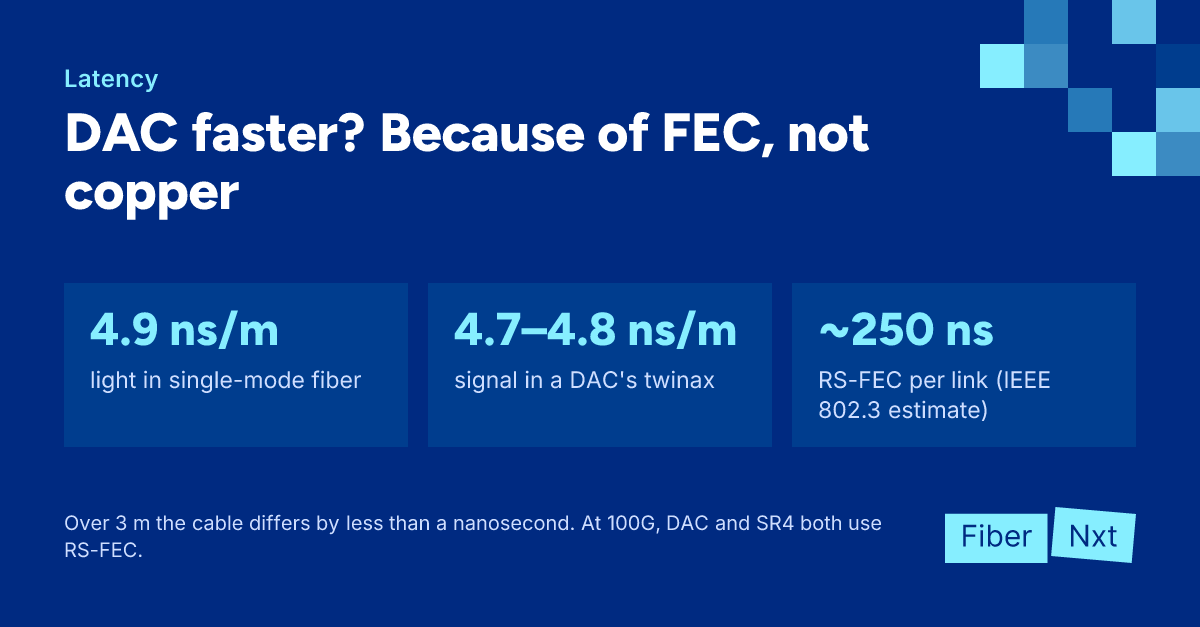
Start with the myth. Copper isn't meaningfully faster than glass. Light in single-modeSingle-mode Fiber with a core of about 9 µm (OS1/OS2, yellow) that carries light in a single mode. Suited to distances from a few kilometres to far beyond. fiber has a group index of about 1.467, so it covers a metre in roughly 4.9 ns. The signal in a DAC's twinax travels at about 70% of the speed of light: around 4.7 to 4.8 ns per metre, depending on the cable.
Over a 3 m link, that's under a nanosecond. If a DAC is faster, the reason lies elsewhere.
Where the nanoseconds really go
Latency in a short link comes from roughly four sources, plus propagation in the cable itself:
- Serialization — a 1500-byte frame takes 1.2 µs to clock onto the wire at 10G, 0.48 µs at 25G and 0.12 µs at 100G. Your line rate sets that, not your cable.
- The PHY — this is where types of copper differ wildly. 10GBASE-T (RJ45) uses heavy coding plus LDPC error correction and costs on the order of 2 µs per link. A DAC is a different animal: your switch's SerDes drives the copper directly.
- FEC — from 25G up you often need forward error correction. Estimates from the IEEE 802.3 25G study group (2014) put BASE-R FEC at about 80 ns per link and RS-FEC at about 250 ns. Not a measurement of your switch, but the right order of magnitude.
- Electronics in the module — a retimerRetimer Chip that fully receives the signal, recovers the clock (CDR) and re-transmits it cleanly. Handles more loss than an equalizer, at the cost of power and a little latency. (CDR) or, at PAM4 speeds, a DSP. Every stage that re-clocks or processes the signal costs time. How much varies per module; there's no standard figure.
That propagation is the smallest item of all.
Why a passive DAC wins
A passive DAC has no electronics in the signal path. There's an EEPROM in the shell so your switch knows what's plugged in, and that's it. No laser, no photodiode, no retimer.
The second advantage is FEC. At 25G, IEEE defines three DAC classes. The short, thick, lowest-loss cables (CA-25G-N) may run without FEC. The other classes need BASE-R FEC or RS-FEC. The 25GBASE-SR standard for optics assumes RS-FEC; short-reach optics that run without FEC do exist, but check the datasheet. A short DAC without FEC versus an SR link with RS-FEC is therefore in the order of 250 ns per hop. That's hundreds of times the difference the cable makes.
What AOCs and optics add
An AOC isn't a "fiber DAC". It's a pair of optics with a fixed fiber in between. You get the same conversion to light and usually the same FEC requirements as separate optics at that speed (the vendor decides, so check the datasheet); only the connectors disappear.
How much it matters depends on the speed:
- 10G — many SFP+ optics have no retimer on board, and 10GBASE-SR and -LR don't use FEC. The gap to a DAC is small. The real 10G latency gap is SFP+ versus 10GBASE-T.
- 25G — the difference is mostly FEC: a DAC without it versus optics with RS-FEC.
- 100G — 100GBASE-CR4 (DAC) and 100GBASE-SR4 (optics) both use the same Clause 91 RS-FEC. The DAC's FEC advantage largely disappears.
- 400G and up — optics usually carry a DSP. Linear pluggable optics (LPO) drop it, specifically to save power and latency. We supply 400G on quote.
When it matters, and when it doesn't
It matters when you count latency in hundreds of nanoseconds:
- Trading — every hop counts, and a few hundred nanoseconds per link is money.
- Storage and RDMA — RoCE and NVMe-oF depend on short, predictable latency; per-hop FEC adds up across a fabric.
- HPC — MPI traffic with small messages is sensitive to latency per hop.
- In-rack ToR — server to top-of-rack switch is exactly the distance a DAC is made for. It's also cheaper and draws less power there.
It doesn't matter for an ordinary office or virtualization environment, where your application thinks in milliseconds. There you choose on distance, cable bulk and airflow. A long passive DAC is thick and stiff; beyond a few metres, or between racks, an AOC or optics with a patch cord is often simply the better cable.
Let us look at your design
Latency is a design decision, not a cable decision. FEC settings on both ends, the DAC class, your switch platform and the distances in your rack together decide what you get. Measure first: our patch cable length calculator gives you a length per connection, so you can pick the shortest cable that fits.
Then browse DAC cables, AOC cables or 25G SFP28. Building a low-latency fabric, or unsure how FEC will negotiate between two switch brands? Send us your design: we'll think it through with you and send a quote. Want the links installed and tested as well? Have a look at our services.

Founder of FiberNxt and Xyphen IT
Yvan Watchman is the founder of FiberNxt and Xyphen IT. He has been building and running networks and data centre infrastructure in and around Amsterdam for years.
Related products and services
Frequently asked questions
Is copper faster than fiber per metre?
Barely. Light in single-mode fiber takes about 4.9 ns per metre; the signal in a DAC's twinax takes roughly 4.7 to 4.8 ns. Over 3 m that's less than a nanosecond. The gap between a DAC and optics comes from electronics and FEC, not from the cable.
Does an AOC have the same latency as a DAC?
No. An AOC is effectively a pair of optics with a fixed fiber in between. You get the same conversion to light and usually the same FEC requirements as separate optics at that speed. All you lose are the connectors and the loose patch cord.
Should I turn off FEC to cut latency?
Only if the link can live without it. At 25G, a short DAC from the lowest-loss class may run without FEC; longer DACs and most SR optics count on RS-FEC. Disable FEC on a link that needs it and you trade a few hundred nanoseconds for bit errors and retransmits.