Laser bias current: the early sign your optic is wearing out
Your switch shows 38 mA laser bias current or a bias high alarm. What the number means, why there's no fixed normal and which pattern really points to wear.
Your switch reports 38 mA laser bias current, or your monitoring throws "laser bias current high alarm". Is the optic on its way out, or is the rack just running hot? This article explains what bias current is, why 38 mA is fine on one module and an alarm on another, which pattern actually signals wear, and how to read and judge it on your own gear.
What bias current is
A laser diode only starts lasing above a minimum current, the threshold current. Past that point, optical power rises roughly in step with current. The current that keeps the laser in that operating range is the bias current.
The transceiverTransceiver Pluggable module that converts electrical signals from a switch or NIC to light (or copper) and back. Transmitter and receiver in one housing, such as an SFP+ or QSFP28. keeps its Tx power constant with a control loop, the APC loop. A monitor photodiode measures the outgoing light and the driver adjusts bias to match. As the laser ages it needs more current for the same light, and the loop supplies it. That's why wear shows up in bias first, while Tx power still looks perfectly healthy. SFF-8472 says so itself: a manufacturer may define a bias warning as an end-of-life indicator.
What's normal? It depends on the module
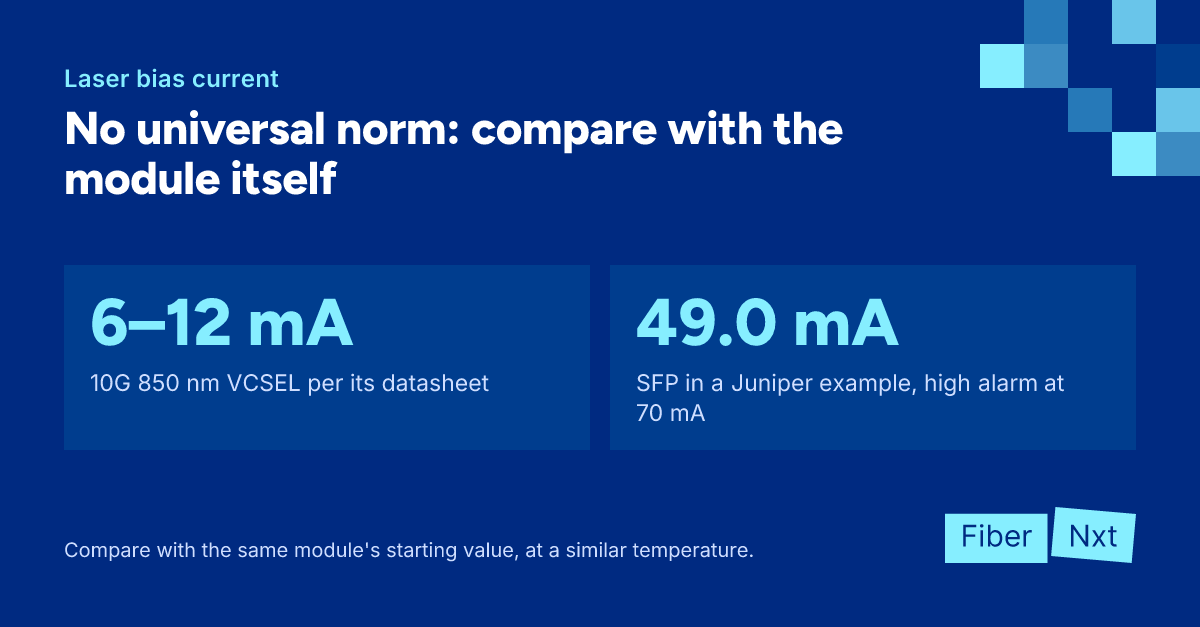
There's no universal figure:
| Source | Laser | Bias |
|---|---|---|
| Moog 104-00056 datasheet | 850 nm VCSEL, 10G | 6 to 12 mA, max 15 mA |
| Lasermate T13D-R-LCMD-I-10G datasheet | 1310 nm DFB, 10G | threshold 10 to 15 mA, specified at threshold + 20 mA |
| Juniper sample, SFP | not stated | 23.4 mA, high alarm 31 mA |
| Juniper sample, SFP | not stated | 49.0 mA, high alarm 70 mA |
So 38 mA trips the alarm on the first SFP and is unremarkable on the second. The manufacturer stores the thresholds in the module, and SFF-8472 notes they vary by technology and implementation. The reading itself may be off by up to 10%. Don't compare against a number from a forum; compare against your own module's thresholds and its own history.
Temperature: bias rises on healthy lasers too
A warm laser has a higher threshold, so it needs more bias for the same output. In the VCSEL datasheet above, the threshold shifts by up to 1.2 mA across the temperature range. An Intel patent (US11177620) puts it bluntly: at high temperature the current rises significantly, and crossing an arbitrary threshold doesn't mean the laser is about to fail. A fixed threshold therefore raises false alarms in a hot summer, and can warn too late on a laser that degrades fast. Compare bias against the same module's starting value, at a similar temperature.
The wear pattern
- Bias creeps up, Tx power stays flat — the loop is compensating. In a qualification study of 1550 nm laser diodes that references Telcordia GR-468, 20% bias drift from the starting value counts as the failure criterion. That's a lab criterion under accelerated ageing, not an alarm level for your switch, but it gives you the order of magnitude.
- Bias sits at its maximum, Tx power drops — the loop has run out of headroom. A Meta patent (US10461851) calls this the high-risk stage and states the module may have only one to three weeks left. That's a patent claim, not a proven prediction.
What bias won't tell you
To be honest: plenty of optics give no warning at all. A Huawei presentation to the IEEE 802.3ba task force (2008) on field returns of VCSEL transceivers reports that over 90% of VCSEL failures were due to dark line defects (crystal defects) or ESD, not wear. Those die suddenly.
And when a link shows packet corruption, the laser is rarely to blame. In Microsoft's study of packet corruption across 350,000 links (SIGCOMM 2017), a decaying transmitter caused less than 1% of cases. Dirty connectors (17 to 57%) and damaged fiber (14 to 48%) scored far higher. Bias is one signal, alongside Tx power, Rx power on both ends and temperature.
How to read and judge bias
These commands are read-only:
- Cisco IOS XE —
show interfaces <port> transceiver detail - Juniper —
show interfaces diagnostics optics <interface> - Arista —
show interfaces <port> transceiver dom thresholds - Linux —
ethtool -m <interface>
Over SNMP, watch the units. JUNIPER-DOM-MIB reports in 0.001 mA, so 38000 means 38 mA. Nokia's TIMETRA-PORT-MIB reports in 1/500 mA: divide by 500 (for internally calibrated modules). Multi-lane QSFPs report bias per lane.
- Read bias, Tx power, temperature and the module's own thresholds.
- Check the unit before you draw conclusions from SNMP data.
- Find an earlier reading from the same module at a similar temperature.
- Check whether Tx power stays flat or drops while bias climbs.
- Check Rx power at the far end and clean the connectors first if the link shows errors.
- Get a spare with the same coding ready once bias is at its maximum and Tx power is falling.
Tracking bias without a spreadsheet
Praevisio, our beta, tracks bias, Tx/Rx power and temperature for each module against its own baseline, plus CRC/FEC errors and flaps. Raw data is kept for at least 90 days and aggregated for up to 2 years, which is what it takes to tell ageing apart from a hot summer. Advice starts with the cheapest cause: "Clean the connection first. Praevisio then measures again for fifteen minutes. Only if the advice stays the same: swap the transceiver." Your data stays in the Netherlands. Interested? Join the waitlist.
If an optic's bias is already at its ceiling, put a spare on the shelf now; here's how to sort spares and same-day replacement. Clean with a Clear Connection Tool and find replacements under optics. Not sure about a reading? Call an engineer.

Founder of FiberNxt and Xyphen IT
Yvan Watchman is the founder of FiberNxt and Xyphen IT. He has been building and running networks and data centre infrastructure in and around Amsterdam for years.
Related products and services
Frequently asked questions
What is a normal laser bias current?
There's no single number. A 10G 850 nm VCSEL runs at 6 to 12 mA according to its datasheet, a 1310 nm DFB laser is specified at around 30 mA. Compare your reading with the thresholds stored in the module itself, and above all with what the same module showed earlier.
What does a laser bias current high alarm mean?
Bias has crossed the high alarm threshold the manufacturer programmed into the module. That can be wear, but also a hot module. Check Tx power and temperature right away: if Tx power holds steady, the laser is still compensating. If it drops while bias stays high, get a spare ready.
Is my optic dying if bias goes up?
Not necessarily. A slow rise against the module's own starting value, at a comparable temperature, points to ageing. But many optics fail suddenly with no trend beforehand. Bias is one signal, not a guarantee.