MPO vs LC: when do MPO trunks and cassettes make sense?
Planning 40G, 100G or 400G, or a dense row of racks? When MPO trunks with cassettes pay off, when duplex LC is enough, and where polarity goes wrong.
You're planning 40G, 100G or 400G, or fitting out a row of racks that will soon carry hundreds of fibers. Do you move to MPO trunks with cassettes, or stay with duplex LC? Here's which optics need MPO, where polarity, pins and polish go wrong, what cassettes do to your loss budget, and how to choose.
Start with the optic, not the cabling
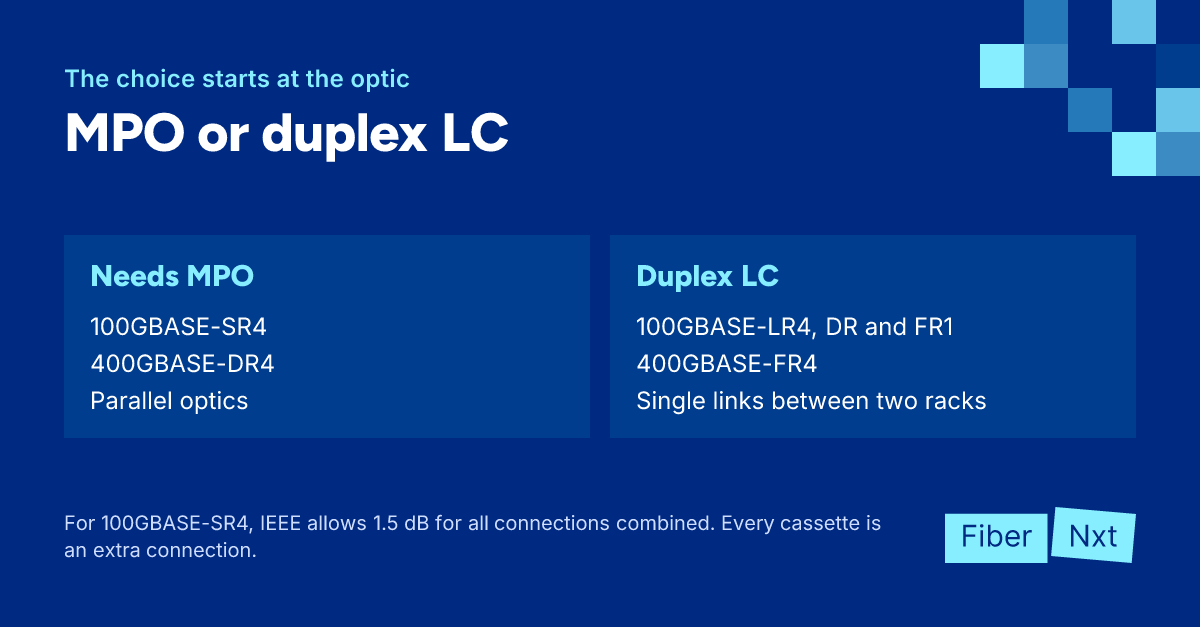
The decision starts at the transceiverTransceiver Pluggable module that converts electrical signals from a switch or NIC to light (or copper) and back. Transmitter and receiver in one housing, such as an SFP+ or QSFP28., not at the patch panel. Parallel optics send each lane over its own fiber pair, so they need an MPO connector. Optics that put their lanes on different wavelengths over one pair, or run a single 100G lane, use duplex LC.
| Optic | Connector | Fiber | Reach (spec) |
|---|---|---|---|
| 40GBASE-SR4 | MPO-12 (8 fibers) | multimode | 150 m OM4 |
| 100GBASE-SR4 | MPO-12 (8 fibers) | multimode | 100 m OM4 |
| 100G PSM4 | MPO-12 (8 fibers) | single-mode | 500 m |
| 400GBASE-DR4 | MPO-12 (8 fibers) | single-mode | 500 m |
| 400GBASE-SR8 | MPO-16 or MPO-24 | multimode | 100 m OM4 |
| 100GBASE-LR4, 100G CWDM4 | duplex LC | single-mode | 10 km, 2 km |
| 100GBASE-DR, FR1, LR1 | duplex LC | single-mode | 500 m, 2 km, 10 km |
| 400GBASE-FR4 | duplex LC | single-mode | 2 km |
SR4, PSM4 and DR4 use eight of the twelve positions: four to transmit, four to receive, and the middle four stay empty. On an MPO-12 trunk, that leaves a third of your fibers unused.
MPO-12, MPO-16 and MPO-24
An MPO is a single ferrule with one or more rows of fibers, defined in IEC 61754-7. MPO-12 is one row of twelve, MPO-24 two rows of twelve. MPO-16 is a row of sixteen with an offset key, so it won't mate with an MPO-12; you'll meet it with 400GBASE-SR8. MTP isn't a different connector, just US Conec's brand name for an MPO with tighter tolerances.
Polarity, pins and polish: where it goes wrong
With duplex LC, you swap a pair and the link comes up. With MPO, transmitter 1 has to land on receiver 1 at the far end, across a trunk, any cassettes and two patch cords. TIA-568.3-D gives three example polarityPolarity The way fibers are mapped from transmitter to receiver. For MPO, TIA-568.3-D defines three methods (A, B and C); trunk, cassettes and patch cords in one link must all follow the same method. methods for that:
- Method A — a straight trunk (position 1 to 1), with a flipped patch cord at one end.
- Method B — a trunk that reverses the order (position 1 to 12), with the same patch cords at both ends. A common choice for parallel optics.
- Method C — a trunk that flips each pair. Works for duplex, but isn't recommended for parallel optics.
Mix methods within one link and it won't come up. Pick one for the whole data center.
On top of that, every connection has exactly one pinned (male) side and one unpinned (female) side. In practice a transceiver's MPO port is pinned, so the cord that plugs into it is female; check the datasheet. Two males can damage pins and end faces; two females have no guide pins, so they don't align.
Then there's polish. The optic decides: PSM4 and DR4 call for APC, with the end face polished at an 8-degree angle, while SR4 is flat. So single-mode MPO is usually APC and multimode flat. APC against a flat end face gives high loss, usually no link, and can damage both end faces.
Trunks and cassettes: density and migration
MPO's strength is density. One trunk of 24 fibers or more replaces a bundle of duplex cables and still fits through a tray that LC has already filled. In the rack you mount MPO-LC cassettes: LC ports for 10G or 25G today, and later you patch the same trunk straight into an SR4 or DR4 optic, no new cable.
The catch is in your loss budget. Every cassette is an extra connection: an MPO at the back, an LC at the front. A link with two cassettes therefore has four more connections than a direct patch. And high-speed multimode leaves little room: for 100GBASE-SR4, IEEE allows 1.5 dB for all connections combined, within a 1.9 dB channel. A few standard MPOs and LCs eat into that quickly, so pick connectors with a low guaranteed insertion loss.
Cleaning matters more with MPO than with LC: one end face carries twelve or more fibers, and one speck of dust takes a lane down. Inspect with a scope that handles MPO and clean with a cleaner made for MPO.
When to choose which
- A few links between two racks — stay with duplex LC. With 100GBASE-DR, FR1 or LR4 you don't need MPO.
- A row or hall with lots of 100G or 400G ports — MPO trunks with cassettes. You save tray space and can move to parallel optics later without new cabling.
- Breakout to 4× 10G, 4× 25G or 4× 100G — MPO, because that's how you split an SR4 or DR4 optic across separate LC ports.
- Unsure about 400G — go single-mode. DR4 and FR4 both run over OS2. An MPO-12 APC trunk feeds DR4 directly and FR4 through an MPO-LC cassette.
We'll help you with the design
MPO trunks, cassettes and 400G optics are deliberately not in the webshop. Fiber count, polarity, pins, polish and length all have to match, and you'd rather catch a mistake on paper than during installation.
Send us your situation: which optics you run now and want later, how many ports per rack, the distances and what's already in the trays. We'll put together trunks, cassettes and patch cords, calculate the insertion loss and send you a quote. Call or email an engineer, or see our services for testing after installation. You can order individual 100G QSFP28 optics and OS2 patch cables straight from the webshop.

Founder of FiberNxt and Xyphen IT
Yvan Watchman is the founder of FiberNxt and Xyphen IT. He has been building and running networks and data centre infrastructure in and around Amsterdam for years.
Related products and services
Frequently asked questions
Can I connect an MPO-12 to an MPO-16?
No. MPO-16 has sixteen fibers in a row and an offset key, precisely so you can't plug it into an MPO-12 by mistake. If you want 400GBASE-SR8 on existing MPO-12 infrastructure, you need a conversion cable or cassette, and that adds insertion loss.
What's the difference between MPO and MTP?
MTP is a US Conec brand name for an MPO-compatible connector with tighter tolerances. It mates with any MPO built to IEC 61754-7. For your design, what matters is the insertion loss per connection the supplier guarantees.
Why isn't MPO in the webshop?
Because an MPO installation only works when polarity, pins, polish and fiber count match on both ends. One wrong trunk and every link on it is down. We'd rather look at your design first and then send you a quote that fits.