DAC vs AOC vs optics: what to use in the rack and across the row
Passive DAC, active copper, AOC or transceivers with a patch cord? Reach, power, cost, cable bulk, breakout and coding compared, plus a checklist.
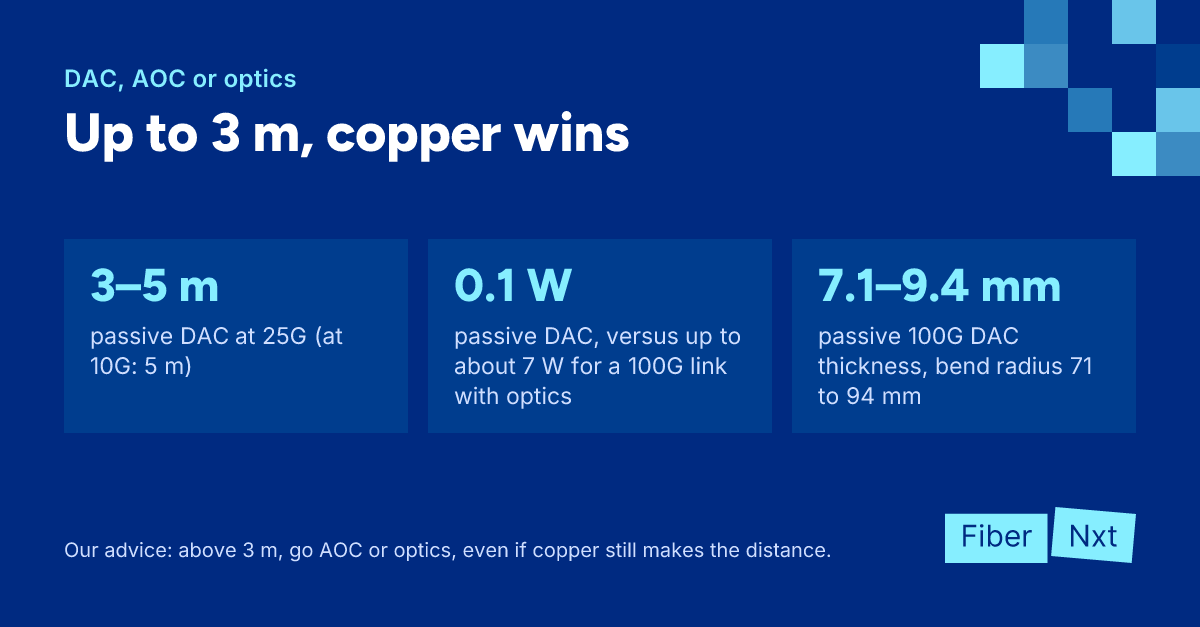
You're fitting out a rack: a row of 25G servers to the top-of-rack switch, a few uplinks to the rack next door, and the order has to go out today. Do you use a DACDAC Direct Attach Copper: a copper cable with a fixed transceiver housing on each end. Cheap and low-power for short runs, typically a few metres within the rack. everywhere, an AOCAOC Active Optical Cable: a fixed fiber cable with the optics built into its ends. Thinner and longer-reaching than a DAC, but the cable cannot be replaced separately., or transceivers with a patch cord? Below we put reach, power, cost, cable bulk, flexibility, breakout and coding side by side, with a checklist per connection at the end. Latency isn't covered here; we wrote a separate piece on that.
Distance makes the first cut
A passive DAC has no electronics in the signal path: the switch drives the copper directly. That only works over short runs, and the higher the speed per lane, the shorter the run.
| Speed | Passive DAC, typical maximum | Basis |
|---|---|---|
| 10G SFP+ | 5 m | SFF-8431; vendors sell passive up to 5 m |
| 25G SFP28 | 3 to 5 m | IEEE 802.3by; Cisco: FEC needed above 2 m |
| 40G QSFP+ | 5 m (standard: at least 7 m) | IEEE 802.3ba |
| 100G QSFP28 | 5 m | IEEE 802.3bj |
| 100G per lane (400G-CR4, 800G) | around 2 m | IEEE 802.3ck |
Between passive copper and fiber sits active copper. An ACCACC Active Copper Cable: a DAC with an equalizer chip in the connector that compensates for the copper's signal loss. Reaches further than passive copper at low power, but does not re-clock the signal. has an equalizer chipEqualizer chip Chip that boosts the high frequencies a copper cable attenuates most, so the signal is readable again at the far end. Also called a redriver. It does not recover the clock, so noise is amplified along with the signal. in the cable; an AECAEC Active Electrical Cable: a copper cable with a retimer at each end that fully recovers and re-transmits the signal. The longest reach on copper, at the cost of more power and some added latency. has a retimerRetimer Chip that fully receives the signal, recovers the clock (CDR) and re-transmits it cleanly. Handles more loss than an equalizer, at the cost of power and a little latency. at each end. That stretches copper to roughly 5 to 7 m, but you pay in power: a 400G AEC from Credo draws about 4.5 W per end. It mostly matters above 100G, and we supply 400G on quote.
An AOC covers up to 10 m at 10G and, depending on vendor and speed, tens of metres at 100G. Optics with a patch cord take 10G SR to 300 m over OM3. So between racks in a row, the real question is whether the route through the cable tray stays within those few metres. Measure it first.
Power and cost: copper wins inside the rack
A passive DAC draws next to nothing: NVIDIA and Cisco list 0.1 W, for the EEPROM. At 10G, Cisco puts an active twinax cable, an AOC and an SR optic at around 1 W each. At 100G it climbs: an AOC draws about 2.2 W per end according to NVIDIA (Cisco lists 3.5 W), an SR4 optic up to 3.5 W. A 100G link with two optics costs up to about 7 W, against a few tenths of a watt for a DAC.
Cost follows the same pattern. In our own shop at the time of writing, a 1 m 10G AOC costs well over twice as much as a DAC of the same length, and two optics plus a patch cord close to four times as much.
Cable bulk, bend radius and airflow
This is where copper loses. NVIDIA's passive 100G DAC is 7.1 mm thick in 30 AWG and 9.4 mm in 26 AWG, the heavier gauge you need for longer cables. Its minimum bend radiusBend radius The smallest radius a cable may be bent to without signal loss or damage. Manufacturers state it in mm, often as a multiple of the cable diameter. near the connector and for repeated bends is ten times the diameter: 71 to 94 mm. A 100G AOC is 3 mm thick with a 30 mm bend radius.
Forty-eight thick DACs in front of a switch is a curtain: bad for airflow, and pulling a module out of the middle becomes fiddly work. Long passive DACs are stiff on top of that. Our advice: above 3 m, move to AOC or optics, even if copper still makes the distance.
Flexibility, breakout and coding
A DAC or AOC is a single part: cable and modules are fixed together. Damaged, or 50 cm short? You replace the whole thing. With optics and a separate patch cordPatch cord Short, pre-terminated cable with connectors on both ends (for example LC-LC) that connects equipment to a patch panel or to each other. you only swap the cord, and your optics move with you to another port or a longer route.
Breakout variants exist in copper and fiber: QSFP+ to 4× SFP+ and QSFP28 to 4× SFP28 as DACs up to 5 m, and QSFP+ to 4× SFP+ as an AOC up to 10 m as well. Check that your switch supports breakoutBreakout One high-speed port split into several slower ones, for example a 100G QSFP28 into 4× 25G SFP28 with a breakout cable. The switch must support it. on that port.
Then there's codingCoding The vendor identification in a transceiver's EEPROM. Many switches only accept optics coded for their own brand.. A DAC or AOC has its own EEPROM at each end, and each end can be coded for a different vendor. Connecting a Cisco switch to a server with an NVIDIA NIC? Then don't ask for "a Cisco DAC": tell us both platforms so we can match the coding on each end. For how coding works, see our piece on third-party optics.
How to choose per connection
- Measure the actual cable route for each connection, including the cable tray and slack.
- Pick a passive DAC when the route fits the table and the bundle won't block airflow.
- Pick an AOC when the route is longer, or when the rack is full and thin cable makes the difference.
- Pick optics with a patch cord when links move often or the distance exceeds what an AOC reaches.
- Note the vendor and model of the switch or NIC at each end for the coding.
- Check the FEC setting on both ends for 25G DACs longer than 2 m.
Start with the patch cable length calculator: enter rack, U position and route, and you get a length we actually supply. Then pick from our DAC cables, such as the 10G DAC and the 100G DAC, the AOC cables or our optics. Our optics come from Solid Optics, a Dutch company. They're tested in the Netherlands, including on customer equipment, and carry a lifetime warranty. Need breakouts, MPO or 400G, or unsure about coding between two vendors? Send us your list and we'll turn it into a quote.

Founder of FiberNxt and Xyphen IT
Yvan Watchman is the founder of FiberNxt and Xyphen IT. He has been building and running networks and data centre infrastructure in and around Amsterdam for years.
Related products and services
Frequently asked questions
How long can a passive DAC be?
It depends on the speed. At 10G, vendors sell passive DACs up to 5 m. At 25G, IEEE 802.3by targets 3 and 5 m (with FEC on the longer cables), and at 100G the 802.3bj target is 5 m. At 100G per lane, as in 4-lane 400G and 800G cables, it drops to around 2 m.
Can I use a DAC between switches from two different vendors?
Yes, as long as both ends accept the cable. A DAC has its own EEPROM at each end, and suppliers can code each end for a different vendor. Give us both platforms when you order.
Is an AOC the same as two optics and a patch cord?
Electrically close, practically not. The fiber is fixed to the modules: no connectors to clean, but no loose patch cord to swap either. If the cable is damaged or too short, you replace the whole assembly.