Copper SFP (RJ45): heat, power and reach of 1G-T and 10G-T
RJ45 in an SFP or SFP+ port? What a 1G-T or 10G-T module draws, how hot it runs, how far it reaches, and when a DAC or fiber is the smarter choice.
Your switch only has SFP or SFP+ ports, but something needs a copper cable: a firewall, an access point, a server with an RJ45 NIC. A copper SFP looks like the easy way out, and at 1G it is. At 10G you get a module that runs hot, draws more than the port was designed for and reaches less far than you'd think. Below: what to expect from each, what to check before ordering, and when a DACDAC Direct Attach Copper: ein Kupferkabel mit fest montiertem Transceivergehäuse an beiden Enden. Günstig und sparsam für kurze Strecken, meist wenige Meter innerhalb des Racks. or fiber is the better call.
1G-T: low power, mostly painless
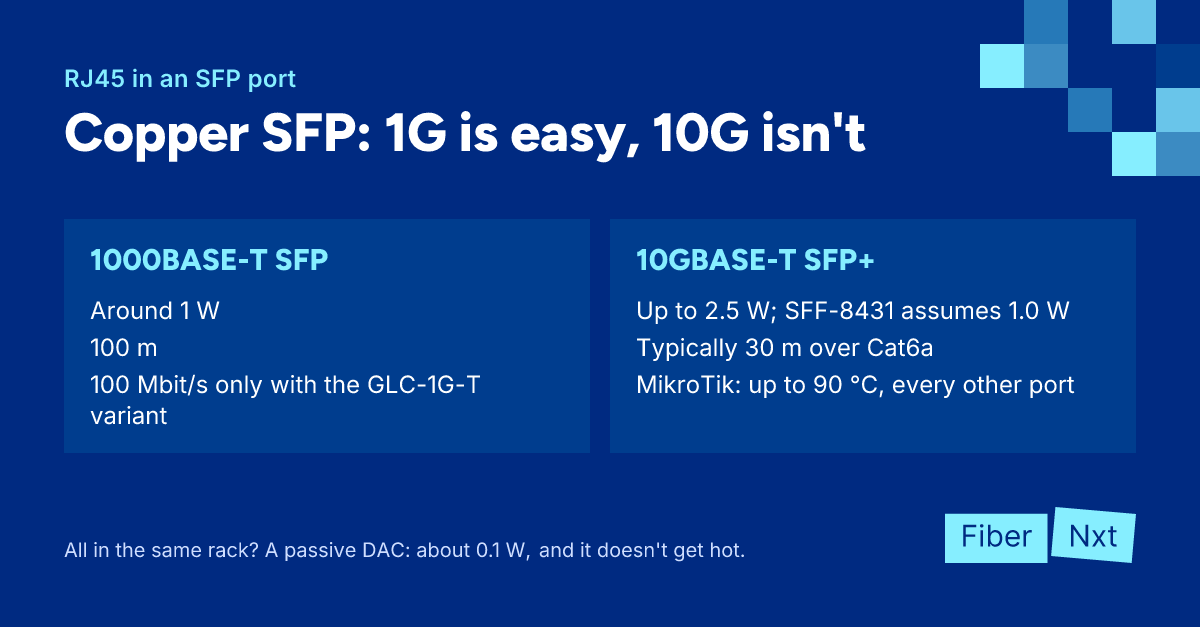
A 1000BASE-T SFP draws around 1 W, well within what any SFP port supplies, and gives you the full 100 m over Cat5e. Our Solid Optics 1G modules draw 300 mA at 3.3 V typical (350 mA max) according to the datasheet, reach 100 m over Cat5 and are specified for 0 to 70 °C.
The catch is speed. A copper SFP only does 10 or 100 Mbit/s if the switch drives the port over SGMII. If the port has a plain 1000BASE-X interface, the module runs at 1000 Mbit/s only, and an old 100 Mbit/s device gets no link at all. That's why there are two variants: an SFP-1G-T that only does 1000 Mbit/s, and a GLC-1G-T that also speaks 10 and 100 Mbit/s if your switch supports it. We ship the GLC variant as standard; the 1000 Mbit/s-only variant is available on request. Also leave auto-negotiation on: 1000BASE-T needs it to bring the link up.
10G-T: more power than the port was built for
The 10GBASE-T PHY transmits over all four pairs at once and has to cancel echo and crosstalk in real time. That takes power. Cisco and several other vendors quote 2.5 W maximum, MikroTik states an average of 2.7 W on a 30 m link, and some modules list 3 W.
Compare that with the power levels the SFP+ spec (SFF-8431) defines: 1.0 W by default, then 1.5 W and 2.0 W if the switch enables that level. A 10G-T module sits above all of them, and some vendors print a warning that their module draws more than the SFP MSA allows.
Cisco states plainly that you can't populate every port with its 10G-T module; which ports are allowed depends on the model. Extreme Networks says: no more than half the SFP+ ports, every second port, and the adjacent port left empty. So read your switch's hardware installation guide before you order eight of them.
Heat and airflow
Those 2.5 W have to go somewhere. MikroTik notes its 10G-T module can reach 90 °C itself while specified for 0 to 70 °C. Their advice: every second port, with an empty port or a regular optic in between, or else extra airflow or a cooler room.
A full row of copper SFPs in a passively cooled switch in a wiring closet is asking for trouble: a module running beyond spec can start flapping or drop out, usually on the hottest day of the year. Once unlatched it can be hot: MikroTik mentions up to 90 °C. And don't count on reading its temperature: not every 10G-T module has DOM/DDMDOM/DDM Digital Optical Monitoring / Digital Diagnostic Monitoring: Der Transceiver meldet live Temperatur, Versorgungsspannung, Laserstrom sowie Sende- und Empfangsleistung..
Reach, speeds and latency
The 10GBASE-T standard reaches 100 m over Cat6a, but that assumes built-in RJ45 ports. An SFP+ module has less power and cooling, and the common spec is 30 m over Cat6a or Cat7. There are 80 m modules, and modules that also do 1G usually reach 100 m at that speed. If your run is 45 m, a 30 m module is out of spec at 10G.
Some modules only do 10G. Multi-rate modules also speak 1G, 2.5G and 5G, but only if the switch drives the port over an interface that handles multiple speeds (USXGMII). On a plain 10G port (XFI) most modules stay at 10G; a few handle lower speeds themselves (rate adaptation), but only if the datasheet says so explicitly. For a 2.5G access point, check both module and port.
Then latency: the 10GBASE-T PHY costs on the order of 2 µs per link, a DAC a few nanoseconds. Irrelevant in an office, not in storage or trading; see our latency post.
- Look up in your switch's installation guide which ports may take a 10G-T module, and how many.
- Measure the cable route: does it stay under 30 m at 10G, or do you need an 80 m module?
- Check which speeds the far end speaks, and whether your port supports 1G, 2.5G or 5G.
- Leave a port free between two 10G-T modules, or make sure there's enough airflow.
- Pick the coding for your switch's brand.
When to pick something else
A copper SFP is for a few devices with an RJ45 port. Beyond that, there's a better tool:
- Switch to switch or server in the same rack — a passive DAC draws about 0.1 W, stays cool and adds almost no latency. At 10G it reaches up to 5 m.
- Longer than a few metres, or between rooms — a 10G SR optic draws around 1 W and reaches 300 m over OM3. At 10G, two optics and a patch cord are often more efficient than two copper modules and don't have the heat problem.
- Lots of copper ports — then you want a switch with built-in 10GBASE-T ports, not a row of modules in SFP+ cages.
What to do next
For a single copper connection at 1G, take the SFP-1G RJ45. For 10G there's the SFP-10G RJ45, provided the checklist above holds. Both come from Solid Optics, a Dutch company, with a lifetime warranty and coded for your switch. Same rack? Look at DAC cables or 10G SFP+ optics first. Not sure your switch can handle the power? Ask us: we test in the Netherlands, on your equipment if needed.

Gründer von FiberNxt und Xyphen IT
Yvan Watchman ist Gründer von FiberNxt und Xyphen IT. Er baut und betreibt seit Jahren Netzwerke und Rechenzentrumsinfrastruktur in und um Amsterdam.
Passende Produkte und Dienstleistungen
Häufig gestellte Fragen
How far does a 10GBASE-T SFP+ module reach?
Usually 30 m over Cat6a or Cat7 at 10G. The 10GBASE-T standard reaches 100 m, but that assumes a built-in RJ45 port with more power and cooling. 80 m modules exist, and modules that also do 1G usually reach 100 m at that speed.
Can I plug a 10G-T module into any SFP+ port?
Not blindly. At roughly 2.5 to 3 W, the module draws more than an SFP+ port normally supplies. Many switches limit how many ports, or which ones, may take a 10G-T module. Check your switch's hardware installation guide.
Does a 1000BASE-T SFP also run at 100 Mbit/s?
Only if your switch supports it over SGMII. If the port has a plain 1000BASE-X interface, the module runs at 1000 Mbit/s only and a 100 Mbit/s device won't get a link.