G.657A vs G.652D: what bend radius means for your patch cords
G.657.A1, A2 or G.652.D on a single-mode patch cord? What the codes mean, which bend radius and macrobend limits apply, and what bend-insensitive won't fix.
You're ordering single-mode patch cordsPatch cord Short, pre-terminated cable with connectors on both ends (for example LC-LC) that connects equipment to a patch panel or to each other. and one listing says "G.652D" while the next says "G.657A1" or "G.657A2". Or you're staring at a packed rack or a cramped FTTH box, wondering whether those loops behind the door are a problem. This post explains what the codes mean, which bend radius and loss figures go with them, whether you can mix them, and what bend-insensitive fiber won't do for you.
G.652.D: the standard that's already in the wall
G.652.D is the regular single-modeSingle-mode Fiber with a core of about 9 µm (OS1/OS2, yellow) that carries light in a single mode. Suited to distances from a few kilometres to far beyond. fiber you buy as OS2. The ".D" means low water peak: low attenuation around 1383 nm, so the whole window from 1260 to 1625 nm is usable. It's what runs through most buildings, campus networks and data center routes.
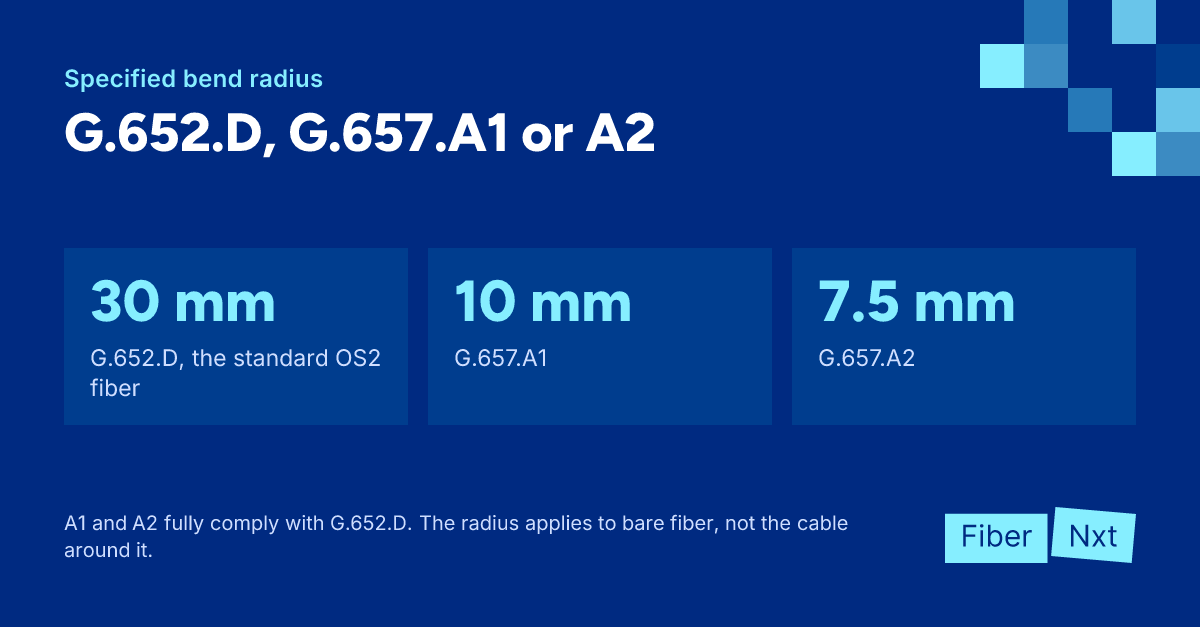
For G.652 the ITU works with a 30 mm bend radius. The macrobend test is 100 turns at 30 mm with no more than 0.1 dB of added loss at 1625 nm. That 30 mm comes from the size of a splice tray, where fiber lies neatly coiled. A patch cord folded hard behind a cabinet door is a different situation.
G.657: A1, A2 and B3
G.657 is the bend-insensitive family, originally written for FTTH: street cabinets, meter cupboards and routes through buildings. The trick is a ring of lower-index glass around the core (the trench) that confines the light better at a bend.
| Category | Specified bend radius | Max. macrobend loss (1550 / 1625 nm) |
|---|---|---|
| G.652.D | 30 mm | 100 turns at 30 mm: 0.1 dB at 1625 nm |
| G.657.A1 | 10 mm | 1 turn at 10 mm: 0.75 / 1.5 dB |
| G.657.A2 | 7.5 mm | 1 turn at 7.5 mm: 0.5 / 1.0 dB; at 10 mm: 0.1 / 0.2 dB |
| G.657.B3 | 5 mm | 1 turn at 5 mm: 0.15 / 0.45 dB |
Two things stand out. Loss is always higher at 1625 nm than at 1550 nm, because the longer the wavelength, the less tightly the light is held in the core. And at the same 10 mm, A2 may lose at most 0.1 dB where A1 is allowed up to 0.75 dB. Since the 2024 edition, the old B2 category has been folded into A2.
B3 is meant for tight in-building routing. It's "compatible" with G.652.D but doesn't have to be fully compliant. In a rack, A1 or A2 is enough.
Mixing with G.652.D: go ahead
According to the ITU, G.657.A1 and A2 are fully compliant with G.652.D. A G.657.A patch cord on a G.652.D trunk works, through a connector or through a splice. The mode field diameter differs a little at most. As an example, a Prysmian G.652.D cable is specified at 9.2 µm at 1310 nm and their G.657.A2 fiber at 8.8 µm, and the tolerances overlap.
You will see that difference on an OTDR, though. A splice between two fibers with different mode field diameters shows a gainer from one side and too much loss from the other. Measure in both directions and average. The real splice loss is usually small.
Where bend-insensitive really helps
- Dense patch panels — cords that drop from a panel into a cable trough easily go below 30 mm.
- Doors and side channels — slack coiled behind a door or stuffed into a vertical manager.
- FTTH boxes and meter cupboards — little room, tight loops, and usually someone who'll open it again later.
- Longer wavelengths — at 1550 nm and above, as with ER, ZR or DWDM optics, every tight bend shows up in your power budget sooner.
Our take: if you're buying single-mode patch cords, buy G.657.A. For patch cords there's little reason left to pick plain G.652.D.
What it won't fix
Bend-insensitive isn't a free pass. A few misconceptions worth correcting:
- Cable bend radius isn't fiber bend radius — the 7.5 or 10 mm (A2 / A1) applies to bare fiber. The jacket, the aramid yarn and the connector boot have their own limits. The FOA's rule of thumb is 10 times the cable diameter once installed and 20 times while pulling; the manufacturer's spec takes precedence.
- Kinks and crush — a kink, an over-tightened cable tie or a door closing on the cord damages the fiber. No trench helps with that.
- Long-term stress — the minimum bend radius is a loss spec, not a lifetime guarantee. Fiber bent permanently at around 6 mm already sits at roughly the strain it's proof-tested at in the factory. The ITU warns about this itself.
- Hidden problems — because you barely see any loss, you notice a bend that's too tight later. If you measure at 1550 and 1625 nm and only 1625 nm shows extra loss, suspect a bend before a bad splice.
What to do now
Walk your patch routes: no kinks, no doors pinching cords, cable ties loose enough that the cord can slide. Our OS2 LC-LC patch cords and SC-LC are G.657.A, so they comply with G.652.D, just like the fiber already in your building. Still choosing between fiber types? Read single-mode vs multimode first. Link down or flapping? Work through the SFP checklist, or have us measure the loss through our services.

Founder of FiberNxt and Xyphen IT
Yvan Watchman is the founder of FiberNxt and Xyphen IT. He has been building and running networks and data centre infrastructure in and around Amsterdam for years.
Related products and services
Frequently asked questions
Can I connect a G.657.A patch cord to a G.652.D link?
Yes. According to the ITU, G.657.A1 and A2 are fully compliant with G.652.D. You can mix them, splice them and mate them through connectors, with only small extra loss.
Is G.657.A2 better than A1?
A2 can be bent tighter (7.5 mm versus 10 mm) and has stricter macrobend limits. That's handy for a patch cord in a crowded rack, but A1 is already a big step up from plain G.652.D.
Why does my OTDR show a gainer at a splice between G.657 and G.652?
Because of a small difference in mode field diameter. Measure the splice from both directions and average the two, and you're left with the real loss, which is usually small.