Single-mode vs multimode: OS2, OM3 and OM4 compared
OS2 or OM4, OM3 or OM4? Distances per standard, what optics and fiber really cost, and when you're better off running single-mode everywhere.
You need to order patch cables or a trunk, and the question is: OS2, OM3 or OM4? Or you've inherited a room where all three are mixed. This article covers how far you get per fiber type and speed, what optics and fiber really cost, and why for new builds we increasingly say: just run single-mode everywhere.
The difference in one paragraph
MultimodeMultimode Fiber with a 50 µm core (OM3/OM4/OM5) that carries light in multiple modes. Cheaper optics, but limited to a few hundred metres. has a wide core (50 µm for OM3 and OM4). Light travels along several paths that don't quite arrive at the same time. The faster your signal, the sooner that spread breaks the link. The measure for it is modal bandwidth: OM3 reaches 2000 MHz-km at 850 nm, OM4 4700 MHz-km. That's why OM4 goes further.
Single-modeSingle-mode Fiber with a core of about 9 µm (OS1/OS2, yellow) that carries light in a single mode. Suited to distances from a few kilometres to far beyond. (OS2) has a core of about 9 µm and a single path. Distance becomes a matter of power budget, not bandwidth. Hence 10 km, 40 km or more on the same fiber.
Distances per standard
The multimode distances come from IEEE 802.3. For single-mode we list the short variants; longer is always possible.
| Standard | OM3 | OM4 | OS2 |
|---|---|---|---|
| 10GBASE-SR | 300 m | 400 m | — |
| 25GBASE-SR | 70 m | 100 m | — |
| 40GBASE-SR4 | 100 m | 150 m | — |
| 100GBASE-SR4 | 70 m | 100 m | — |
| 100GBASE-DR | — | — | 500 m |
| 10GBASE-LR | — | — | 10 km |
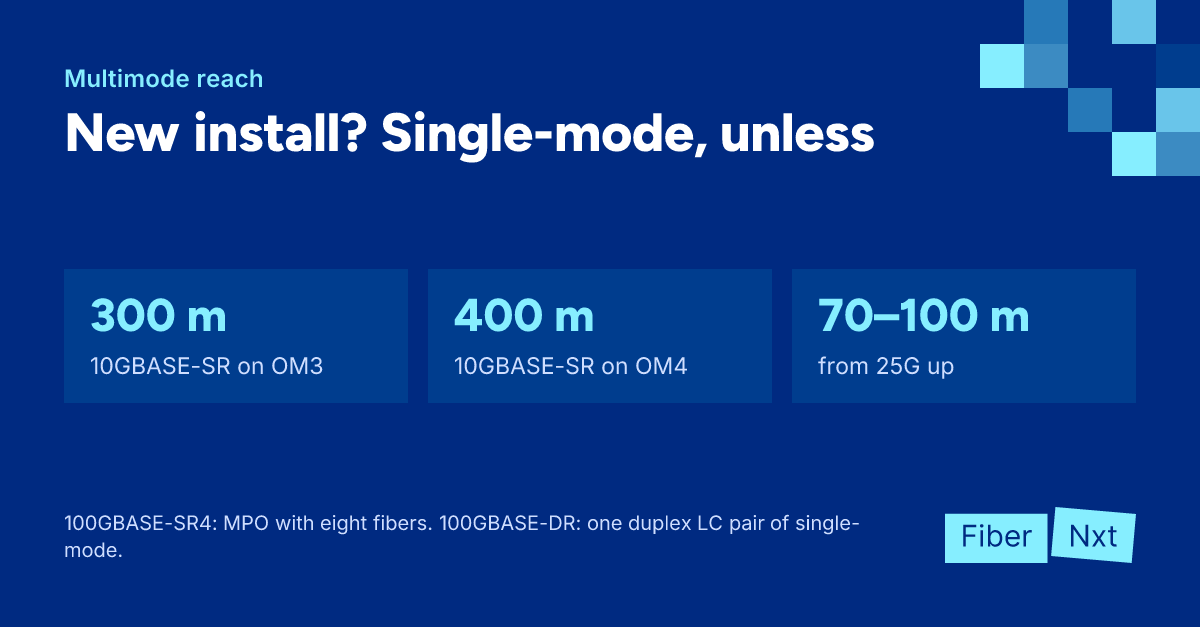
See the pattern? At 10G, multimode still covers a room comfortably. From 25G it drops to 70 to 100 m. In a large hall, or between two halls, that doesn't get you far. And 100GBASE-SR4 uses an MPO connector with eight fibers, where 100GBASE-DR on single-mode needs just one duplex LC pair.
OM3 or OM4?
Short answer: if you're installing new multimode, OM4. The price difference is small and you get a third to half more reach at every speed.
OM3 and OM4 mate: same core, same connectors. An OM3 patch cord in an OM4 route works, but then you use the OM3 distance. As for OM5: same performance as OM4 at 850 nm, plus specs up to about 950 nm for optics that send several wavelengths over multimode. You rarely see those optics in practice. Only buy it if you're actually going to use them.
What it really costs: optics and fiber
The old argument for multimode was that the optics are much cheaper. That's still true, but the gap is smaller than many people think. In our own shop, a 10G SR and a 10G LR optic differ by a few euros each at the time of writing.
And the fiber? That's where it gets interesting. A 20 m OS2 patch cord is currently cheaper in our shop than the same length of OM4 or OM3. Prices move, but the lesson stays: don't go on gut feeling, do the sums on your own quote.
Where multimode does stay clearly cheaper is lots of short, high-speed connections within a row. There, the number of optics and the price per optic decide it.
When to run single-mode everywhere
We increasingly say: run OS2 unless you have a good reason not to. Why:
- No distance ceiling — today's room is tomorrow's campus. With OS2 you don't have to recable at the next speed step because 70 m is suddenly too short.
- One fiber type — one kind of patch cord, one kind of spare, less chance of an OM3 cable ending up in a single-mode link at 4 pm.
- Duplex LC stays — with single-lambda optics like 100GBASE-DR you stay on a duplex LC pair, where multimode moves to MPO at 100G.
- Bend-insensitive — our OS2 patch cords are G.657.A, compatible with the G.652.D fiber in most buildings and more tolerant of tight bends in a full rack.
Multimode still makes sense when you're extending an existing multimode room, or when you have lots of short 10G links where optics are most of your budget.
Colors, briefly
Single-mode is usually yellow, OM3 and OM4 aqua (OM4 sometimes violet), OM5 lime green. But color is a convention, not proof. Read the print on the jacket. We'll go deeper into color codes on 23 December.
What to do now
Ordering patch cables for an existing link? Check which fiber is in the route first and match it. Installing new? You've read our opinion. All cables are in the shop, and if you're unsure about a room full of existing cabling, we'll take a look with the DC cabling quickscan on our services page.

Founder of FiberNxt and Xyphen IT
Yvan Watchman is the founder of FiberNxt and Xyphen IT. He has been building and running networks and data centre infrastructure in and around Amsterdam for years.
Related products and services
Frequently asked questions
Can I mix OM3 and OM4?
Yes. Both are 50/125 µm multimode with the same connectors, so they mate and the link works. Your reach is set by the weakest section though: if there's OM3 anywhere in the route, use the OM3 distances.
Does a multimode optic work on single-mode fiber?
No, not reliably. An SR optic is built for multimode and an LR optic for single-mode. Optic and fiber have to match, at both ends of the link.
Is there a multimode BiDi SFP?
At 1G and 10G, BiDi optics are single-mode. Multimode BiDi does exist at 40G and 100G: two wavelengths around 850 and 900 nm over a regular duplex multimode pair. At 40G that gets you about 100 m over OM3 and 150 m over OM4.