Choosing 100G single-mode optics: DR1, FR1, LR1, LR4 or CWDM4?
LR4, CWDM4 or single-lambda DR1, FR1 and LR1? How they differ in lanes, PAM4 and FEC, which ones interoperate, and what to pick with 400G on the roadmap.
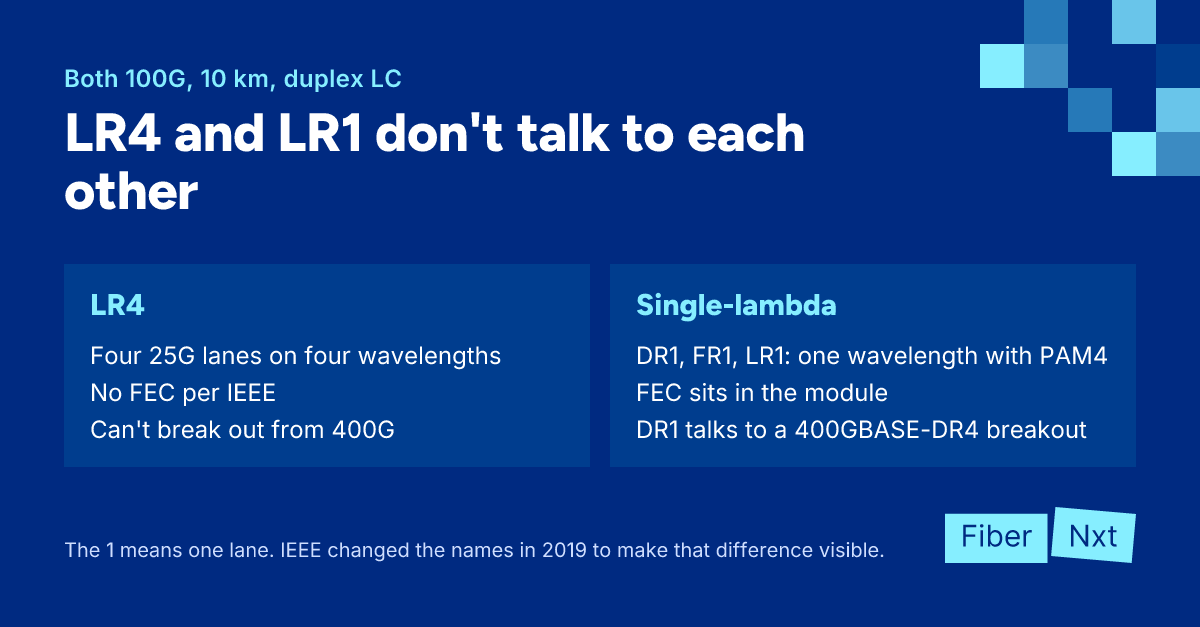
You need 100G over single-mode, and the order list shows LR4, CWDM4, DR1, FR1 and LR1. They all fit the same QSFP28 port and use one duplex LC pair, but they don't all link up with each other. This article explains how they differ, which pairings work and which don't, and which one to buy when 400G is already on the roadmap.
Four lanes or one wavelength
There are two ways to get 100G across a single fiber pair.
- Four 25G lanes — LR4 and CWDM4 put four 25G NRZ signals on their own wavelengthWellenlänge Die Wellenlänge des Lichts in Nanometern. Üblich sind 850 nm (Multimode), 1310 nm und 1550 nm (Singlemode); beide Seiten einer Verbindung müssen dazu passen. each and combine them inside the module. LR4 (IEEE 802.3ba, Clause 88) uses the LAN-WDM grid from roughly 1295 to 1309 nm and reaches 10 km. CWDM4 is an MSA on the CWDM grid at 1271, 1291, 1311 and 1331 nm and reaches 2 km.
- One 100G lane — DR1, FR1 and LR1 carry everything on one wavelength around 1311 nm using PAM4PAM4 Modulation mit vier statt zwei Signalpegeln (NRZ), sodass jedes Symbol zwei Bit trägt. So passen 100G auf eine Wellenlänge, auf Kosten des Signal-Rausch-Verhältnisses; deshalb immer mit FEC., four signal levels instead of two. Your switch still hands the QSFP28 four 25G lanes; a DSP in the module (the gearbox) turns them into a single 100G PAM4 signal.
A common mistake: LR1 is not a flavour of LR4. The "1" means one lane. IEEE renamed FR and LR to FR1 and LR1 in 2019 precisely to make that difference visible.
| Type | Defined by | Lanes | Wavelength | Reach |
|---|---|---|---|---|
| 100GBASE-LR4 | IEEE 802.3ba | 4 × 25G NRZ | 1295–1309 nm (LAN-WDM) | 10 km |
| 100G CWDM4 | CWDM4 MSA | 4 × 25G NRZ | 1271–1331 nm (CWDM) | 2 km |
| 100GBASE-DR | IEEE 802.3cd | 1 × 100G PAM4 | 1311 nm | 500 m |
| 100GBASE-FR1 | IEEE 802.3cu, first the 100G Lambda MSA | 1 × 100G PAM4 | 1311 nm | 2 km |
| 100GBASE-LR1 | IEEE 802.3cu, first the 100G Lambda MSA | 1 × 100G PAM4 | 1311 nm | 10 km |
The standard simply calls DR1 100GBASE-DR; vendors add the 1 to line it up with FR1 and LR1.
What talks to what
Two modules with the same reach are not automatically a pair.
- LR1 and LR4 — no link. Different modulation, different number of wavelengths. Both 10 km, both duplex LC, and the port still stays down.
- CWDM4 and LR4 — no link. Both are four 25G lanes, but on a different grid.
- FR1 and DR — Cisco states its FR1 can also be used where 100GBASE-DR is called for, for example facing a 400G-DR4 in breakout. Confirm that for your module in its datasheet.
The rule is simple: put the same type on both ends, or a pairing the vendor supports in writing.
FEC: who does the work?
A single-lambda link runs at a raw bit error ratio around 2.4 × 10⁻⁴, so it depends entirely on FECFEC Forward Error Correction: Der Sender fügt zusätzliche Parität hinzu, damit der Empfänger Bitfehler selbst korrigiert, ohne erneute Übertragung. Ab 25G oft erforderlich; beide Seiten der Verbindung müssen dieselbe FEC verwenden.. The 100G Lambda MSA and IEEE use RS(544,514), also known as KP4. In a QSFP28 that FEC lives in the module: the DSP handles it and your switch just sees 100G.
That is not what you may be used to. Per IEEE, LR4 uses no FEC at all. The CWDM4 MSA, on the other hand, requires the host to enable RS(528,514) FEC, with no bypass. So when you swap a CWDM4 for an FR1, or an LR4 for an LR1, check the FEC setting on both ports. At least one DR1 datasheet states explicitly that the host must then have FEC turned off.
Why single-lambda is where things are heading
The strongest argument isn't 100G itself, it's 400G. A 400GBASE-DR4 is four parallel 100G PAM4 lanes over an MPO-12 connector, good for 500 m. Cisco breaks it out into four 100G-DR1 links. A DR1 you plug into a 100G switch today can later talk directly to a 400G port on the spine. LR4 and CWDM4 can't do that.
At 2 km the same trick works with a parallel 400G module that vendors sell as DR4+ or XDR4, which breaks out into four FR1 links. Note that 400G-FR4 can't: FR4 puts four wavelengths on one duplex pair and splits them inside the module.
Power is not a deciding factor: Cisco lists all five types between 3.5 and 4.3 W.
Which one to pick
- Inside the data center, up to 500 m — DR1. Especially if 400G is coming.
- Campus or building to building, up to 2 km — FR1 for a fresh build, CWDM4 if the far end already runs CWDM4.
- Up to 10 km — LR4 if the far end is LR4, which in existing networks it often is. LR1 if you choose both ends yourself and want to be on the newer standard.
DR1 and LR4 are in the shop under 100G QSFP28, on the QSFP28-100G product page. FR1, LR1 and CWDM4 aren't listed; just ask. Unsure about the reach of your path? Read how to work out reach and link loss first.
We'll think through your design with you
With 400G on the roadmap, choosing your 100G optics is a design decision, not a line item. Which breakout, which MPO cabling, which FEC setting on which end: you want to know that up front. We supply 400G optics and MPO cabling on quote. Send us your situation: the distances, the switches on both ends and what you expect in two years. We'll think it through with you and send a proposal. Request a quote from an engineer, or look at our services if you also want the links tested and documented.

Gründer von FiberNxt und Xyphen IT
Yvan Watchman ist Gründer von FiberNxt und Xyphen IT. Er baut und betreibt seit Jahren Netzwerke und Rechenzentrumsinfrastruktur in und um Amsterdam.
Passende Produkte und Dienstleistungen
Häufig gestellte Fragen
Can I run a 100G LR1 on one end and an LR4 on the other?
No. Both reach 10 km over single-mode, but LR4 sends four wavelengths with NRZ and LR1 sends one wavelength with PAM4. The receiver on the far end cannot decode the signal. Both ends have to be the same type.
Does a 100G DR1 work with a 400G port?
Yes, if that 400G port takes a DR4 module broken out into four times 100G. Each lane of a 400GBASE-DR4 is a 100G PAM4 lane on the same wavelength as DR1. You need an MPO breakout cable and a switch that supports breakout on that port.
Do I need to enable FEC on my switch?
It depends on the module. The CWDM4 MSA requires RS(528,514) FEC on the host. LR4 uses no FEC. Single-lambda QSFP28 modules run their FEC inside the module, and some datasheets state that the host must then leave FEC off. Read the datasheet for your module and check the port configuration on both ends.